Sailability Manual – Info HUB
Club & Program Handbook · Chapter 3
Risk & Safety Management
Safety is shared by everyone on the water and the shore. This chapter covers the safety systems, ratios, checks and emergency planning every program needs.
Safety is a responsibility shared by all involved in any Sailability activity. It’s the duty of all staff, instructors, carers and volunteers to be vigilant, aware of anything that may affect the safety of themselves or others, and to notify the Program Leader as soon as possible. The points below are highlights adapted from the Australian Sailing Discover Sailing standards — for up-to-date best practice, review Australian Sailing’s Risk & Incident Management resources.
Safety principles
- Site-specific plan. Safety documents should include a Risk Assessment and Risk Management Plan for your site, available to all volunteers, covered in induction, and reviewed annually.
- Emergency Action Plan. Safety procedures should set out the steps for a major incident (first aid, calling emergency services, recording information) and be posted somewhere visible. See Emergency plan.
- Know who’s on the water. Use a system to monitor how many people are afloat at all times.
- Maintain equipment. Keep boats and gear in good condition per manufacturer recommendations, and pull faulty equipment from the fleet until repaired.
- Define the sailing area and make it known to all afloat; the safety boat should be able to see the entire area at all times.
- Watch the weather. Don’t operate on days of strong wind or gale warnings, electrical storms, extreme heat or other adverse warnings. Reef sails or bring sailors ashore if conditions turn unsafe.
- Have a return signal — a simple signal for all boats to return to shore, known by everyone afloat.
- Radios. VHF radios are recommended; operators should be licensed and comply with local regulations.
Safety boats & ratios
During sailing activities a safety boat should always be on the water with at least two crew aboard. Drivers must hold a minimum of a Victorian Marine Licence (an Australian Sailing Powerboat Handling certificate is preferred). Safety boats must fully comply with State Marine legislation and regulation, including equipment and operation.
| Number of dinghies | Open water | On a lake / clear view of the dock |
|---|---|---|
| Up to 6 | 2 safety boats | 1 safety boat |
| 7 to 15 | 3 safety boats | 2 safety boats |
| More than 15 | 4 or more | 3 safety boats |
These are minimums — the Supervisor should adopt lower ratios only after assessing participants’ experience, the weather and the locality. If operating within clear view of the dock, the Dock Manager should have radio contact with the safety-boat operator and access to a phone for emergencies.
For Hansa dinghies the best safety boat is a 4–5m inflatable. If a Hansa needs towing, it’s safer to tie it close alongside and remove the rudder blade so it can’t be “steered” in the wrong direction.
First aid
Appoint a First Aid Officer for each session, holding a current first aid qualification from a nationally recognised provider (e.g. Provide First Aid). Encourage all volunteers to complete first aid training. Keep first aid kit(s) in an easily accessible, clearly marked position, check and re-stock them regularly, and carry a kit in each safety boat.
Lifejackets (PFDs)
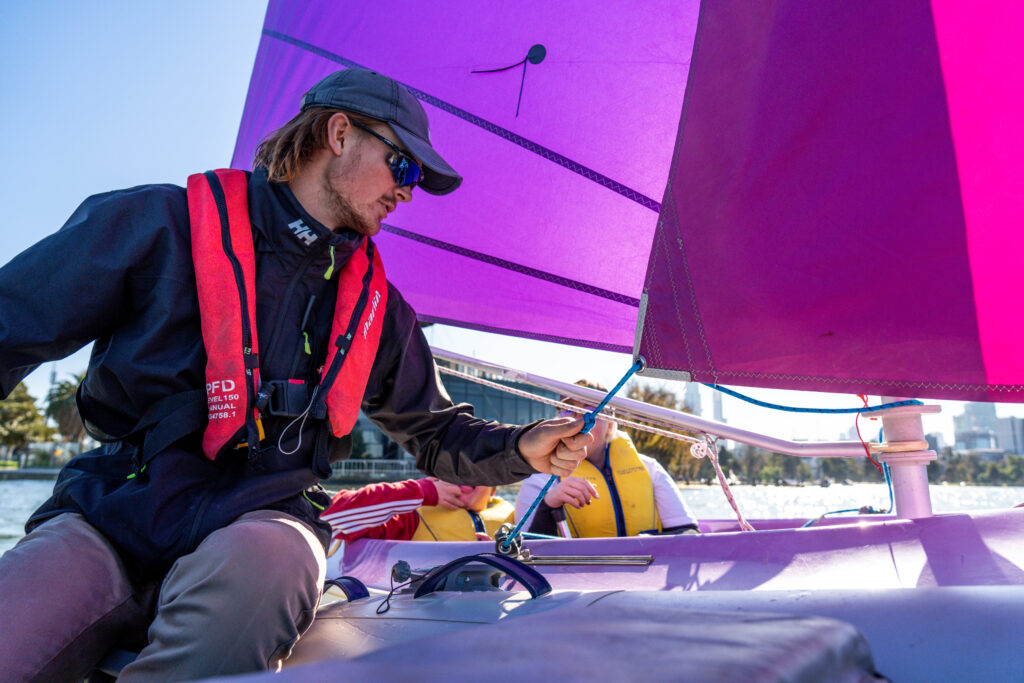
All participants and instructors must always wear a lifejacket on the water that complies with current Australian Standards and State Marine Regulations.
Provide sufficient lifejackets in a range of sizes; participants may supply their own. A lifejacket should fit securely so it won’t slide up the body once immersed — use crotch straps if appropriate. Inspect lifejackets regularly and test or discard any in doubt. See AMSA — “What lifejacket do I need?”. Sailors wear non-inflatable lifejackets wherever possible; where there’s no alternative, an inflatable Type 1 PFD may be used, decided case by case.
Child safety & Working with Children Checks
Many branches run programs with school-aged children or adults with cognitive impairments. People with disabilities are not children and should never be treated as such — but an adult with a cognitive impairment can be at greater risk of exploitation or abuse.
It is a requirement for ALL Sailability Victoria volunteers to hold a valid Working with Children Check. It’s free for volunteers via Service Victoria. Holders must also comply with mandatory reporting — if you have reason to believe someone is being abused, you’re required to report it.
Staff who work with adults with disability generally already hold this check through their employment, so it isn’t unique to Sailability. Volunteers supporting programs on state borders (e.g. Albury–Wodonga) need a check for both states — you can obtain an interstate check regardless of your home address. See Australian Sailing’s Victoria WWCC guidance and the Safeguarding Children and Young People Policy Template.
SunSmart & hydration
In Victoria the UV Index is 3 or above year-round, so sun protection applies whenever you’re outdoors. Encourage everyone to Slip, Slop, Slap, Seek, Slide — and Sip:
- Slip on sun-protective clothing covering as much skin as possible.
- Slop on SPF50+ broad-spectrum, water-resistant sunscreen — 20 minutes before going out, reapplied every two hours.
- Slap on a hat protecting face, head, neck and ears.
- Seek shade.
- Slide on sunglasses that meet Australian Standards.
Encourage everyone to drink plenty of fluids. Some participants can’t drink ordinary fluids (for example, they may need thickened liquids to reduce choking risk) — check with them or their support person when confirming medical/safety information. For long periods afloat, carry drinks, including spares in the safety boat.
Safety considerations for people with a disability
Sailing is a safe sport when sensible policies are followed. Generally the same rules you apply to all participants (like wearing PFDs on docks and near the water) apply to participants with disabilities. A few tasks — like transferring onto a boat — deserve extra thought: is the way you’re doing it safe for you and the participant, and is there a safer way? Brainstorm with instructors, caregivers and the sailors themselves to find what works best. Be alert to participants who may not sense cold or heat, may misjudge their stamina, or have reduced sensation — protect feet and legs from bruising and scrapes with appropriate footwear.
Emergency plan
Each branch should develop an Emergency Procedure Plan for its venue (the host club may already have one — familiarise yourself with it). Supervisors should have a copy available at all times, and it should be covered in all volunteer training. Recommended items to include:
- Location of the nearest telephone (or a mobile on site if none)
- Contact numbers for emergency services, hospital and doctor
- Location of fire extinguishers and the First Aid Kit
- Visual and audible signals to call all craft back to shore
- Vehicular access to the site for emergency services
- Radio communication details between safety boat and shore (channel, call signs)
- A designated shore marshalling area and trained Safety Officers
- A register of all volunteers and participants on the water at any time
- Awareness of specific medical conditions needing attention (e.g. epilepsy, diabetes, heart conditions)
The Supervisor (or Safety Officer) is responsible for activating the Emergency Plan and allocating tasks to responsible personnel.
Incident & injury reporting
Record the details of any incident or injury on the relevant form. These are reviewed by the Committee, followed up where required, and lessons learned are shared across programs.
Incident Report Form: revolutionise.com.au/vicsailability/incident
Injury Report Form: revolutionise.com.au/vicsailability/injury